
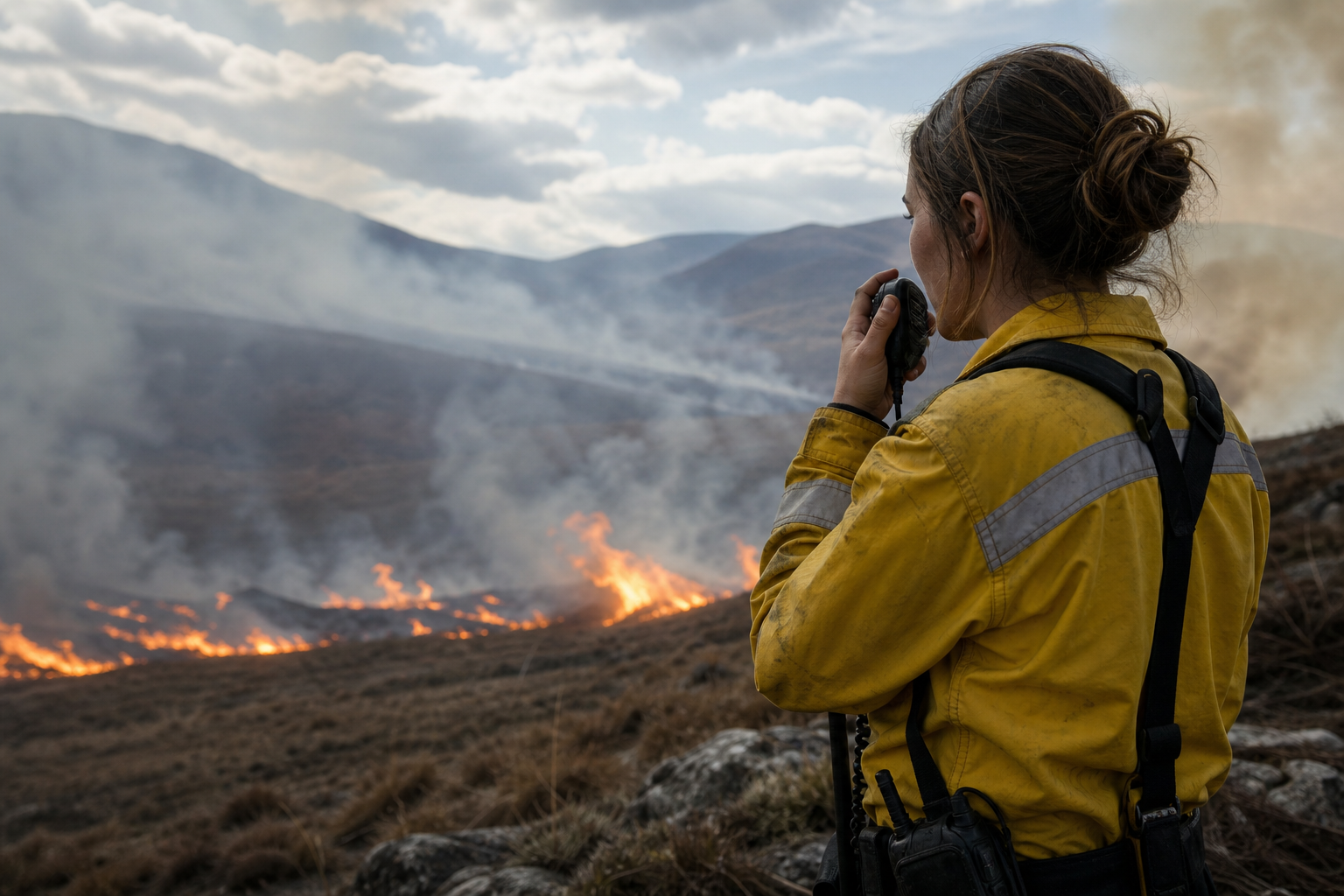
When wildfire risk rises to very high levels, government agencies should warn the public. That is the resolution, and in Scotland this week it is not hypothetical. The Scottish Fire and Rescue Service has issued a wildfire risk warning covering the central Highlands, southern Scotland, and eastern Scotland, effective from Wednesday, with advice for the public to stay vigilant. The stakes are immediate: avoidable ignitions, strained emergency response, property loss, ecological damage, and in the worst cases, injury or death.
The most important point is also the simplest. When a public authority has material information about a foreseeable hazard, withholding or delaying that information is hard to defend. A wildfire risk alert is not ornamental. It is a basic act of public protection. It gives people notice that conditions have changed, that ordinary behavior may now carry extraordinary consequences, and that public services are tracking elevated danger. In any serious framework of duty of care, that matters.
Critics of broad public warnings raised three serious objections in the debate. First, they argued that a general advisory like stay vigilant can be vague, low yield, or even symbolic. Second, they warned that repeated alerts may create desensitization, causing the public to tune out. Third, they suggested that targeted communication to high risk groups is more efficient than region-wide public messaging. These are not frivolous concerns. A warning system can be badly designed. Agencies can overuse generic language. Public attention is finite. And targeted outreach to land managers, farmers, campers, and other high exposure groups is undeniably valuable.
But none of that defeats the resolution. At most, it refines it.
The question is not whether public warnings alone are sufficient. They are not. A wildfire risk warning does not replace land management, fuel reduction, enforcement, emergency planning, or firefighting capacity. It does not absolve the state of investing in prevention infrastructure. It is also true that a warning should ideally include specific advice, not just ambient concern. Better communication is better policy.
Still, the leap from those valid critiques to the claim that agencies should not issue public warnings is where the opposition fails. Information is itself a safety measure. The burden of proof belongs to those who would suppress or narrow it. If officials have assessed risk as very high across named regions, they need a strong justification not to tell people who live, travel, work, or recreate there. The foreseeable harm from silence is obvious; the harm from giving notice is comparatively slight and manageable.
This is where the precautionary principle is not rhetorical excess but ordinary administrative prudence. Wildfires are highly sensitive to conditions, timing, and human behavior. The public does not need perfect individualized instructions for a warning to be useful. A walker may avoid a disposable barbecue. A resident may postpone garden burning. A landowner may inspect access points or water sources. A visitor may pay closer attention to local restrictions. A family may review an evacuation plan. Even those who take no direct action gain situational awareness, which is part of how societies reduce risk collectively.
The strongest cost-benefit argument against broad warnings is that they can become background noise. That concern deserves respect because warning fatigue is real. But the answer is not silence. It is calibration. Agencies should use clear thresholds, plain language, geographic specificity, and updated timing. They should distinguish routine seasonal caution from very high wildfire risk. They should pair general alerts with targeted messages to groups whose conduct most directly affects ignition risk. In other words, the way to preserve trust in warnings is to govern them well, not to abandon them.
There is also a democratic point here. Public risk information should not be treated as a scarce commodity reserved for insiders or a narrow set of presumed decision makers. A region-wide wildfire danger is a public fact with public consequences. People move through these landscapes in different roles, resident, worker, tourist, business owner, volunteer, parent. Agencies cannot reliably predict who will be affected, who can change behavior, or who will need to make secondary decisions about travel, events, care responsibilities, or property. Broad communication is often the fairest way to ensure equal access to safety-critical information.
Some opponents framed warnings as a kind of burden shifting, a way for agencies to say they did something while leaving individuals to cope. That criticism lands only if warnings are used as a substitute for real prevention. They must not be. But it is perverse to argue that because warnings are insufficient on their own, they are somehow suspect. By that logic, seat belt reminders would be objectionable because roads also need engineering and policing. Public warnings are one layer in a layered safety system. Removing a layer does not strengthen the others.
Another objection cast centralized warnings as paternalistic, even as an intrusion on individual judgment. That argument mistakes notice for coercion. A wildfire risk alert does not confiscate autonomy. It informs it. Individual knowledge of one field, one road, or one hillside is not a substitute for regional fire weather assessment by the Scottish Fire and Rescue Service. Personal experience and institutional expertise are complements. The state does not insult the public by sharing hazard information; it respects the public enough to do so.
The debate also surfaced a useful distinction between ideal and effective warnings. That distinction should shape policy design. Yes, agencies should strive for actionable alerts rather than boilerplate. Yes, they should evaluate whether messages change behavior. Yes, they should segment audiences when possible. But a system that waits for perfect measurability before speaking up about a very high wildfire risk misunderstands emergency communication. Public safety often operates under uncertainty. The obligation is not to guarantee that every recipient acts optimally. The obligation is to provide timely, credible notice when danger rises.
That is why the Scottish Fire and Rescue Service made the right call. By issuing a wildfire warning for central Highlands, southern Scotland, and eastern Scotland from Wednesday, and by telling the public to stay vigilant, it performed a core governmental function. The message could always be more detailed. Future alerts should be paired with sharper behavioral guidance and stronger prevention measures. But the foundational choice to warn was correct.
Government agencies should issue public warnings when wildfire risk reaches elevated levels because the alternative is a breach of duty wrapped in false pragmatism. Officials exist in part to detect shared hazards and communicate them before preventable harm unfolds. In wildfire policy, as in any safety regime worth the name, the public should not have to guess what the state already knows.