
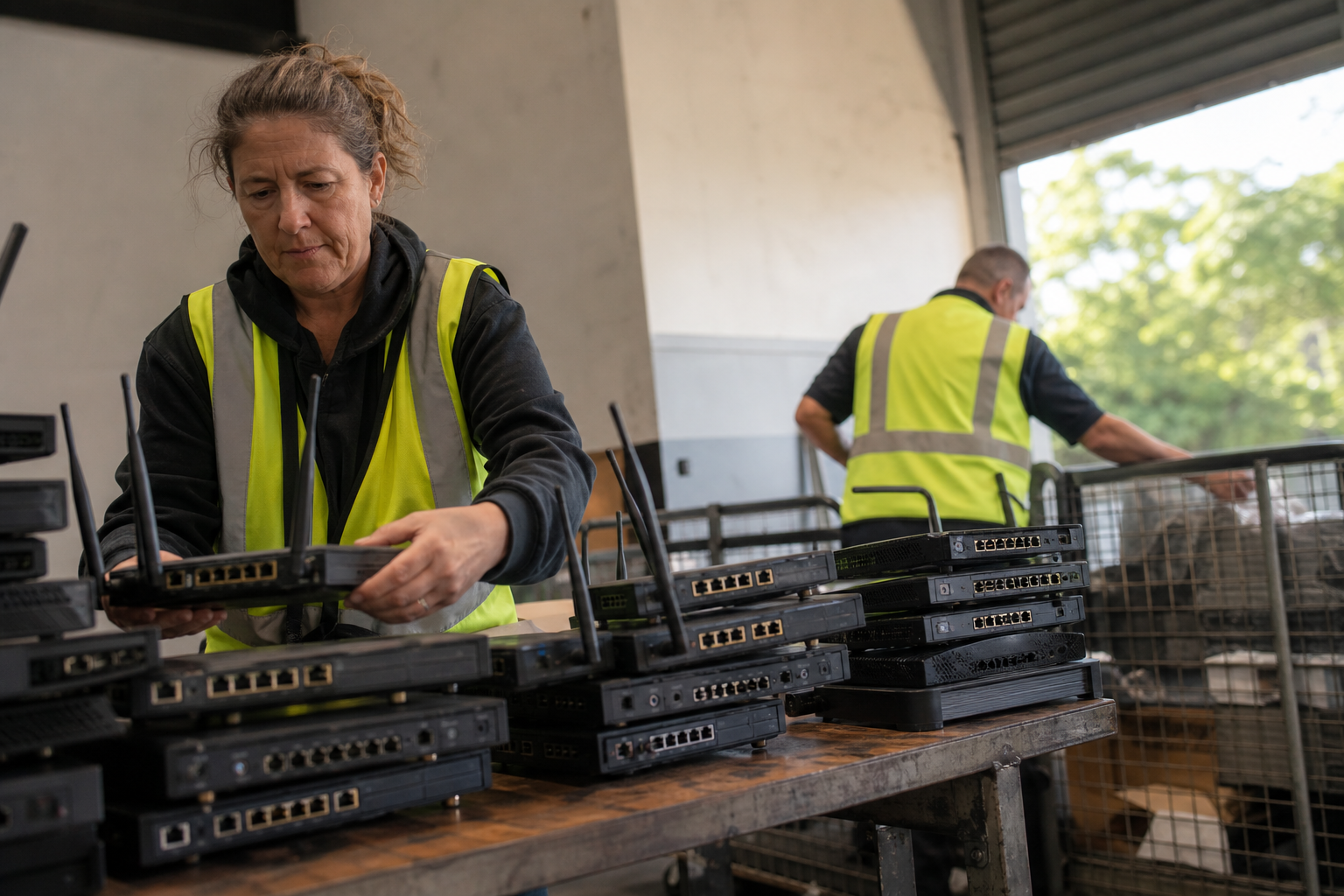
Australia’s order to dispose of thousands of functional test routers used by volunteers looks, at first glance, like a small administrative decision. It is not. It is a revealing case study in how governments handle risk, waste, expertise, and control. When technical experts say the routers can be reflashed, and the state still demands disposal, the issue is no longer just electronic equipment. It is whether public agencies should destroy usable infrastructure rather than allow capable people to extend its life.
They should not.
Government agencies should allow volunteers to repurpose functional electronic equipment rather than requiring disposal, especially when the devices are reported to be in working condition and can be technically sanitized for new use. That does not mean a free for all. It means the default should shift from blanket destruction to structured reuse. The state’s job is to manage risk proportionately, not to erase value because designing a better process is harder than ordering a bin.
The strongest argument for disposal deserves to be taken seriously. These routers were classified as test devices. They were used by volunteers in a government context. That raises legitimate concerns about data remnants, insecure firmware, licensing limits, chain of custody, and liability if a repurposed router later fails or is compromised. A router is not a chair. Network equipment can store configurations, credentials, and software that matter. In some cases, secure destruction really is the right call.
That is the regulator’s best point, and conceding it matters. Not every government device should be handed out. Some equipment contains sensitive information. Some hardware may be bound by procurement terms. Some test units may have unusual radios, unsupported software, or security flaws that make them poor candidates for reuse. If an agency can show that a specific class of device cannot be safely sanitized or lawfully transferred, disposal is defensible.
But that is not what a blanket disposal order says. A blanket order says the bureaucracy has chosen simplicity for itself over value for the public. It treats all uncertainty as if it were catastrophe, all volunteers as if they were incompetent, and all functional hardware as if its only safe end state were destruction. That is not prudence. It is institutional laziness disguised as risk management.
The fact that technical experts stated the routers could be reflashed matters because it changes the nature of the dispute. We are no longer talking about dead equipment or speculative salvage. We are talking about functional routers with a plausible technical pathway to secure reuse. Reflashing is not magic, and it is not a guarantee, but it is a concrete process. It can wipe prior configurations, replace firmware, and return a device to a known state. If the concern is security, the answer is verification. If the concern is data sanitization, the answer is documented erasure. If the concern is accountability, the answer is a transfer protocol. None of those problems require automatic disposal.
This is where the deeper failure of the disposal mindset becomes visible. Centralized institutions tend to optimize for legibility to themselves. A destroyed router creates no paperwork tomorrow. A repurposed router requires judgment, criteria, exceptions, and trust in people outside the chain of command. So agencies reach for the option that minimizes internal friction, even when it maximizes social waste. The result is a brittle system that can only remain safe by forbidding adaptation.
A more resilient approach would start from a different premise. Functional equipment already in the hands of volunteers is a distributed asset, not a contamination event. People closest to the hardware often know the hardware best. Technical communities routinely reflash routers, install open firmware, and document security practices in public. That ecosystem is not perfect, but it is transparent, iterative, and corrigible. Errors are found, methods improve, and knowledge spreads. In network terms, that is healthier than a single administrative command that destroys all value at once.
Critics will say this romanticizes volunteer competence and underestimates public liability. Fair enough. Some volunteers will lack the skills to safely repurpose government test equipment. Some will make mistakes. Some agencies will face legal constraints that a newspaper column cannot wish away. But those facts support screening and process, not mandatory disposal. Governments already make distinctions all the time. They classify records, certify recyclers, auction surplus, and wipe laptops. There is no reason the policy menu here must collapse into only one option: smash first, think later.
What should replace it? A sensible rule would be narrow and auditable. Agencies should assess whether a device is functional, whether it contains sensitive data, whether reflashing or secure wiping is feasible, and whether transfer is legally permitted. If those boxes are checked, volunteers or community groups should be allowed to repurpose the equipment under a documented release. If they are not, the agency can dispose of it. The point is not that every router must be saved. The point is that destruction should be justified, not presumed.
That distinction matters beyond a single batch of test routers in Australia. Electronic waste is expensive, environmentally damaging, and politically revealing. Every time the state orders the disposal of working equipment, it tells the public something about how it values resources and citizen capacity. If volunteers can be trusted to use routers in a test program, they can at least be considered capable of repurposing those same routers under clear conditions. To deny that possibility is to insist that authority alone confers competence.
It also wastes a chance to build better public technology norms. Allowing secure reuse creates incentives for agencies to procure equipment with transferable firmware, documented sanitization procedures, and cleaner end of life pathways. It encourages modularity and interoperability instead of sealed, disposable systems. It invites technical experts into the governance process rather than excluding them after the useful work is done. In short, it makes public infrastructure more forkable, more inspectable, and less dependent on one office making one irreversible decision.
The opponents of repurposing are right about one thing. Safeguards matter. A router touching government systems is not the same as a thrift store appliance. But they are wrong to conclude that the presence of risk requires the elimination of choice. Secure reuse is not the absence of rules. It is a better rule set, one that recognizes the difference between unmanaged circulation and responsible transfer.
This is the real policy conflict. Not safety versus recklessness, but whether safety must always mean centralized destruction. It does not. A government that cannot distinguish between hazardous equipment and functional, reflashable routers is not demonstrating integrity. It is demonstrating a failure of imagination and process.
Public agencies should allow volunteers to repurpose functional electronic equipment because resilience comes from preserving optionality, not extinguishing it. The routers were reportedly working. Experts said they could be reflashed. Volunteers had already been part of the system. In that context, requiring disposal is the brittle choice. It destroys value to avoid designing trustable procedures. A confident public sector should do better than that.
The lesson of these routers is larger than their price tag. Durable systems do not treat every edge node as a threat and every reusable device as a liability. They build protocols that let value move safely outward. When the choice is between a blanket order to destroy and a structured path to reuse, governments should stop acting like incinerators of last resort and start acting like stewards of public resources.