
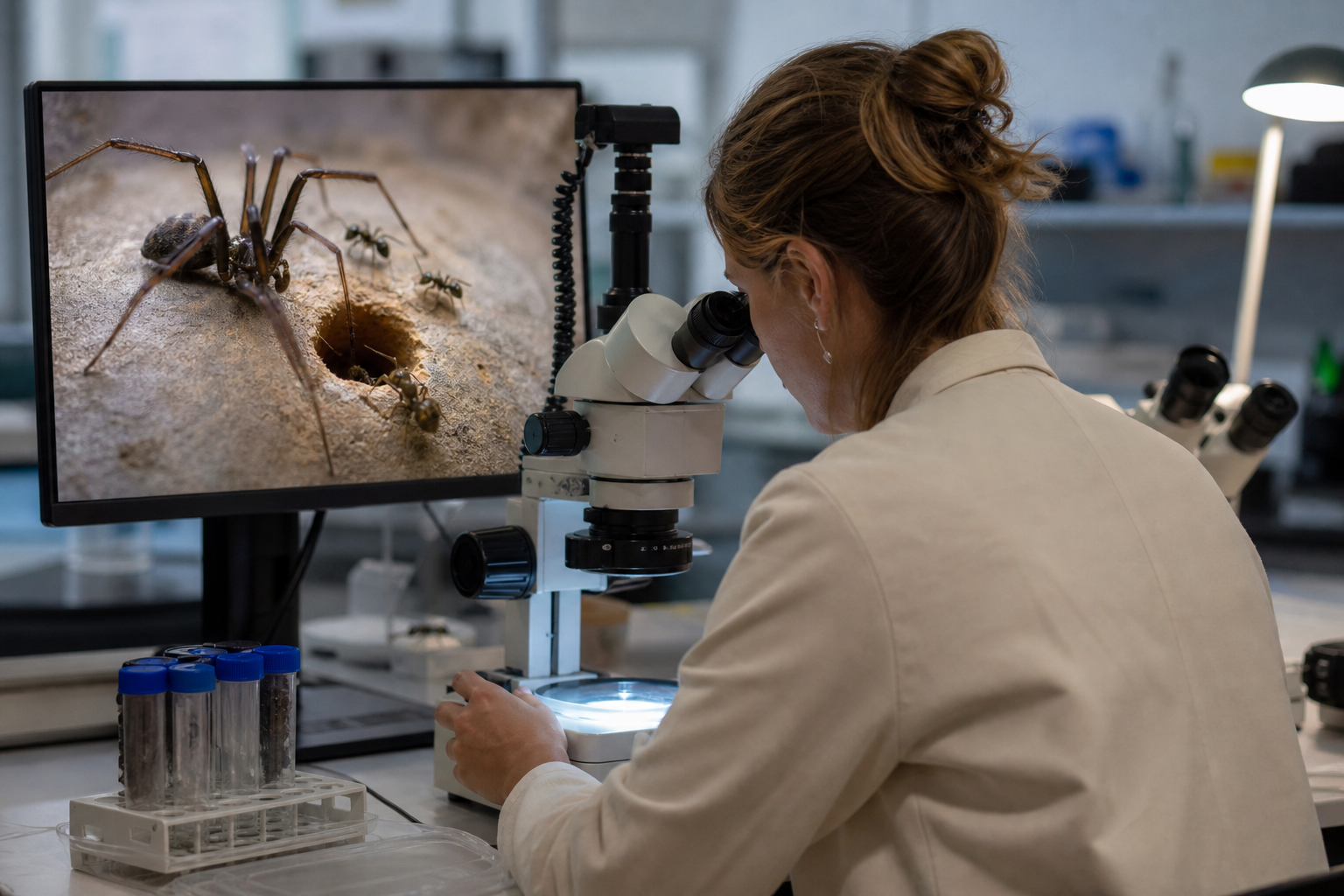
A newly discovered spider species in Australia uses a spring trap mechanism to capture prey, and researchers say the hunting method has not been previously documented. That fact alone is enough to establish the public interest. When nature reveals a genuinely novel predatory mechanism—especially one that allows a small arachnid to overcome dangerous ants—the question is not whether the subject is intriguing. It is whether government funding should prioritize understanding it before ignorance becomes a policy choice. The answer is yes.
The stakes are larger than one spider and one field site. Novel biological mechanisms are public goods in the most literal sense: once discovered and described, the knowledge diffuses outward into ecology, biomaterials, robotics, pest management, and basic evolutionary science. But the path from first observation to usable understanding is expensive, uncertain, and slow. That is precisely why decentralized actors routinely underinvest. Private capital wants nearer-term returns. Universities compete for prestige but cannot reliably sustain broad, coordinated inquiry. Local and ad hoc efforts produce scattered papers, not durable national capacity. If a previously undocumented spring-loaded hunting system exists in arachnids, the state has a clear role in ensuring that it is studied systematically rather than incidentally.
Opponents of prioritization generally make three arguments. The first is fiscal: limited public dollars should go to areas with more immediate or measurable benefits. The second is philosophical: taxpayers should not be compelled to subsidize scientific curiosity. The third is procedural: government should avoid top-down favoritism and let discovery emerge organically through private, academic, or local initiative. These objections sound practical. They are, in fact, a blueprint for chronic underproduction of foundational knowledge.
Start with the cost-benefit critique. Skeptics ask what concrete return comes from studying a spider that catches ants. It is the wrong frame. Public research portfolios are not venture funds seeking instant monetization from every line item. They exist to build a shared stock of knowledge that markets are structurally bad at financing. No private actor can capture the full value of understanding a new predatory mechanism in nature. The ecological implications alone exceed the boundaries of any single lab or firm. A spider that can reliably prey on dangerous ants through a spring trap strategy may illuminate predator-prey dynamics, mechanical evolution, habitat adaptation, and new forms of force storage and release in biological systems. The value here is cumulative and systemic, not reducible to a quarterly output metric.
This does not mean government should fund every curiosity indiscriminately. It means novelty of mechanism matters when it signals a gap in the scientific record. Researchers state this hunting method has not been previously documented. That phrase should focus policymakers. Public institutions are supposed to close high-value knowledge gaps, particularly when the upside is diffuse and the ownership of benefits cannot be privatized. Foundational science is the classic case for state action because the social return exceeds the private return. If government does not step in, society waits for fragmented incentives to accidentally align. They often do not.
The autonomy argument is weaker still. It insists that individuals, not bureaucratic institutions, should decide whether spider research deserves support. But this romanticizes fragmentation and ignores how modern research actually works. No individual taxpayer can assemble longitudinal ecological datasets, maintain museum collections, support field expeditions, build cross-institutional databases, and train specialized biologists at scale. The relevant choice is not between perfect freedom and coercion. It is between coordinated public investment in shared knowledge and a patchwork system where important work is left to chance, philanthropy, or whatever happens to be fashionable among donors. One model is accountable to broad public priorities; the other is accountable to private whim.
The anti-centralization critique deserves more serious engagement because it identifies a real hazard: governments can become rigid. A research bureaucracy can overstandardize, chase metrics mechanically, or privilege familiar institutions. But the answer to those risks is better governance, not abdication. The state is still the only actor capable of setting a coherent national research agenda, integrating ecological and engineering inquiry, and ensuring that findings are openly accessible rather than siloed. Decentralized systems do not solve coordination problems; they merely conceal them. They duplicate effort in some areas, neglect others entirely, and reward projects that can tell an easy story to funders. Novel predatory mechanisms in arachnids are exactly the kind of subject likely to be neglected because their benefits are broad, delayed, and impossible for one actor to capture.
There is also a temptation, voiced by some critics, to say that because the spider appears to prey on dangerous ants, the discovery is probably beneficial and therefore not urgent. This is an oddly narrow understanding of scientific relevance. The significance of a new hunting mechanism is not exhausted by whether it helps control one prey species. Understanding how the spring trap works, how often it evolved, what environmental pressures produced it, and how it changes local food webs are all legitimate public questions. Dangerous ants matter. So does the predator capable of subduing them in a previously unseen way. Ecological systems are not self-explanatory, and governments tasked with environmental management should not wait until a mechanism becomes economically salient before funding the knowledge needed to interpret it.
The strongest affirmative alternative offered in the debate was the accelerationist case: fund this research because nature is a blueprint for innovation, and rapid investigation could unlock robotics, pest control, or materials breakthroughs. That argument is attractive but incomplete. It is right that novel spider hunting strategies can inspire human design. It is wrong, however, to make immediate extraction of commercializable insight the primary rationale. The public case is stronger and more durable. Government should prioritize this research not because every biological discovery must become a product, but because a society that wants resilient ecological policy, equitable access to knowledge, and long-term innovation must invest upstream. Basic science is infrastructure.
That is the decisive point. A centralized state can absorb uncertainty in ways private actors cannot. It can fund field biology that has no obvious sponsor. It can connect arachnid research to broader biodiversity monitoring. It can require data sharing, preserve specimens, and support interdisciplinary teams that ask both ecological and mechanical questions. It can also distribute benefits more fairly. If a novel spring trap mechanism eventually informs pest management or engineering, those gains should emerge from a public knowledge base rather than from a scramble for proprietary control after years of public neglect.
To prioritize government funding for research into novel predatory mechanisms in arachnids is not to fetishize spiders. It is to recognize what responsible governance looks like when confronted with a newly documented fact about the natural world. The Australian spider is important because it reveals that our inventory of biological strategies remains incomplete. A previously unknown spring trap mechanism capable of capturing dangerous ants is exactly the kind of discovery that justifies public investment: specific enough to study, novel enough to matter, and broadly useful enough that society should not leave it to fragmented incentives.
Governments are not meant to fund only the obvious, the immediate, and the easily monetized. They are meant to build the common capacities that dispersed actors will not. In research, as in infrastructure, waiting for spontaneous coordination is usually another name for underinvestment. When a new arachnid predatory mechanism enters the scientific record, the prudent course is clear. Study it publicly, study it seriously, and do so before the costs of neglect are once again socialized after the opportunities of foresight were privatized away.