
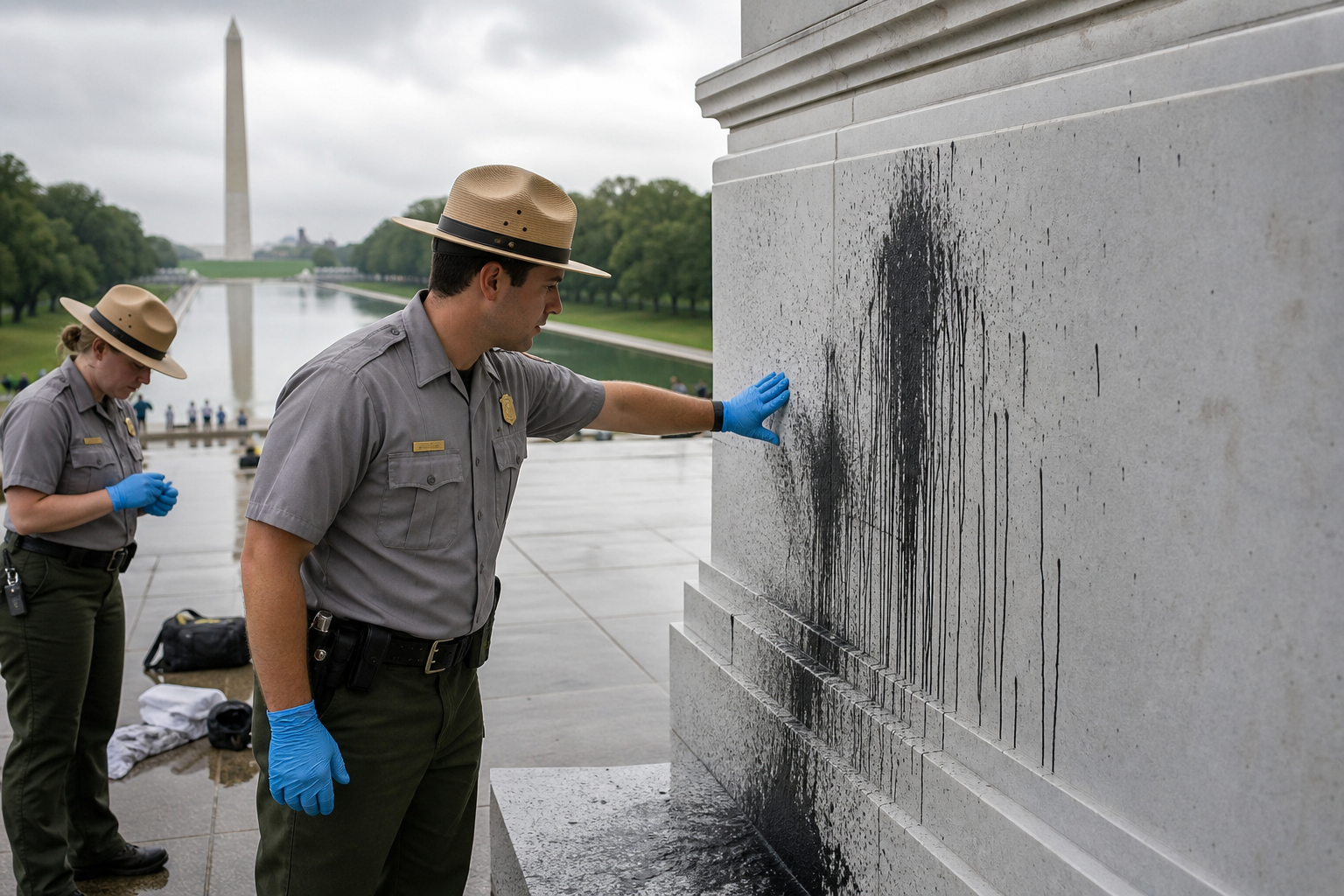
The argument over whether the Trump administration should prosecute people for damage to federal monuments and memorials is not really about one former Olympian, one indictment, or one reflecting pool. It is about whether the federal government will act like a steward of the property entrusted to it. In the case at hand, the administration indicted David Hearn over alleged damage to the National Mall's reflecting pool. His lawyer says he is innocent. That matters, and it must matter. But the existence of a presumption of innocence is not an argument against prosecution. It is an argument for fair prosecution.
This distinction has been obscured by two familiar objections. One says any such case is likely political theater, a federal show trial dressed up as heritage protection. The other says prosecution is too costly, too disproportionate, too blunt an instrument for what may amount to a repair bill. Both objections deserve serious consideration. Neither is ultimately persuasive.
Begin with first principles, which in this context are not ideological abstractions but old constitutional habits. Federal monuments, memorials, and public works on the National Mall are federal property. They are maintained with public funds, held in trust for the whole country, and freighted with civic meaning precisely because they are not merely local amenities. The reflecting pool is not a neighborhood fountain. It sits in a national ceremonial landscape where Americans mourn, protest, commemorate, and instruct their children in the visible grammar of the republic. If the federal government will not protect such places through law, it is difficult to say what public trust means.
That is why the strongest affirmative case in this debate was always the simplest one. There is a long settled principle that government property can be protected by criminal law, and especially so when that property has national significance. This is not a Trump innovation. It is not a novelty of the culture wars. It is part of the basic architecture of state capacity. Every durable government has understood that symbolic public spaces require real enforcement behind the rhetoric of stewardship. Rome guarded its civic monuments, early American governments punished depredations on public property, and modern states treat damage to national memorials as more than a private dispute because the loss is public in both cost and meaning.
The opposing side tried to turn this continuity into a vice. We were told that prosecution may be selective, that some past incidents on the National Mall or elsewhere may have drawn lighter treatment, and that visibility itself is suspicious. But selective enforcement is not proved by the mere fact that this case was charged. Prosecutorial discretion has always existed because law cannot function mechanically. The fact that some offenders escape punishment, or receive civil penalties, warnings, or plea deals, has never established a constitutional or moral entitlement to federal inaction. A republic cannot be governed on the theory that yesterday's underenforcement becomes today's rule.
There is, however, a narrower concern embedded in the criticism that should be conceded. Prosecution can be abused for spectacle. Administrations of both parties have sometimes sought exemplary cases to signal priorities. History gives us ample reason to distrust grandstanding in criminal justice. But that caution counsels evidentiary discipline and procedural fairness, not abandonment of enforcement. The proper answer to politicization is neutral application of law, open court proceedings, and proof. It is not a standing presumption that when the federal government protects federal property it must be acting in bad faith.
The cost and proportionality argument is also more respectable than some defenders of prosecution admit. Federal cases are expensive. Investigations consume resources. Court time is not free. Not every nick, stain, or trespass on federal land merits the full machinery of indictment. A wise government distinguishes between trivial misconduct and conduct serious enough to justify criminal sanction. Prudence matters. So does scale.
But the leap from that premise to the conclusion that the administration should not prosecute is unwarranted. First, deterrence in public property cases cannot be measured only by comparing legal costs to one repair invoice. That is a cramped accountant's view of public order. The relevant comparison includes the accumulated effect of tolerated damage, the copycat incentive created by visible impunity, and the erosion of norms around shared civic spaces. The National Mall is used by millions. If the government signals that damage to monuments and memorials is administratively inconvenient rather than legally consequential, repairs do not remain isolated expenses. They become recurring line items in a larger culture of neglect.
Second, proportionality is not the same as leniency. It means fitting response to offense through lawful process. If the facts are weak, the defendant should prevail. If the damage was accidental, minimal, or unsupported by evidence, an acquittal or dismissal is the proper remedy. But those are reasons to scrutinize a particular case, not to reject the category of prosecution itself. Too much of the criticism treated indictment as if it were punishment. It is not. It is the commencement of adjudication.
That point is especially important in David Hearn's case. The fact sheet gives us very little. We know the Trump administration indicted a former Olympian, that the individual charged is David Hearn, that the charges relate to alleged damage to the National Mall's reflecting pool, and that his lawyer states he is innocent. On those facts, the only responsible position is limited but firm. Hearn is entitled to the full presumption of innocence, to challenge the government's evidence, and to be judged on the facts rather than his biography. Yet none of that changes the underlying policy judgment. An administration should be willing to prosecute alleged damage to a federal memorial site when the evidence justifies it.
The localist objection, that Washington should leave such matters to local communities, fails for a simpler reason. The National Mall is not merely local. It is federal territory in the practical and symbolic sense. Uniform protection of national monuments is one reason these places retain their national character. Fragmented enforcement would invite precisely the inconsistency critics claim to fear, a patchwork in which the treatment of damage to federal memorials depends on local appetite, local politics, or local fatigue. That would not vindicate self-government. It would abdicate national stewardship.
In the end, institutions endure because they are backed by habits of maintenance, not just speeches of admiration. A monument without enforcement is eventually only scenery. A memorial that can be damaged without serious legal consequence becomes one more public object waiting for deferred maintenance funds. The law should not be theatrical, vengeful, or careless. It should be steady. That is the old lesson here.
So yes, the Trump administration should prosecute individuals for damage to federal monuments and memorials, including alleged damage to the reflecting pool on the National Mall, where the facts support the charge. Not because every indictment is wise, and not because every defendant is guilty, but because a government that refuses to defend its own civic inheritance teaches the public that inheritance has no custodian. History suggests what follows when states send that message, and it is rarely reverence.