
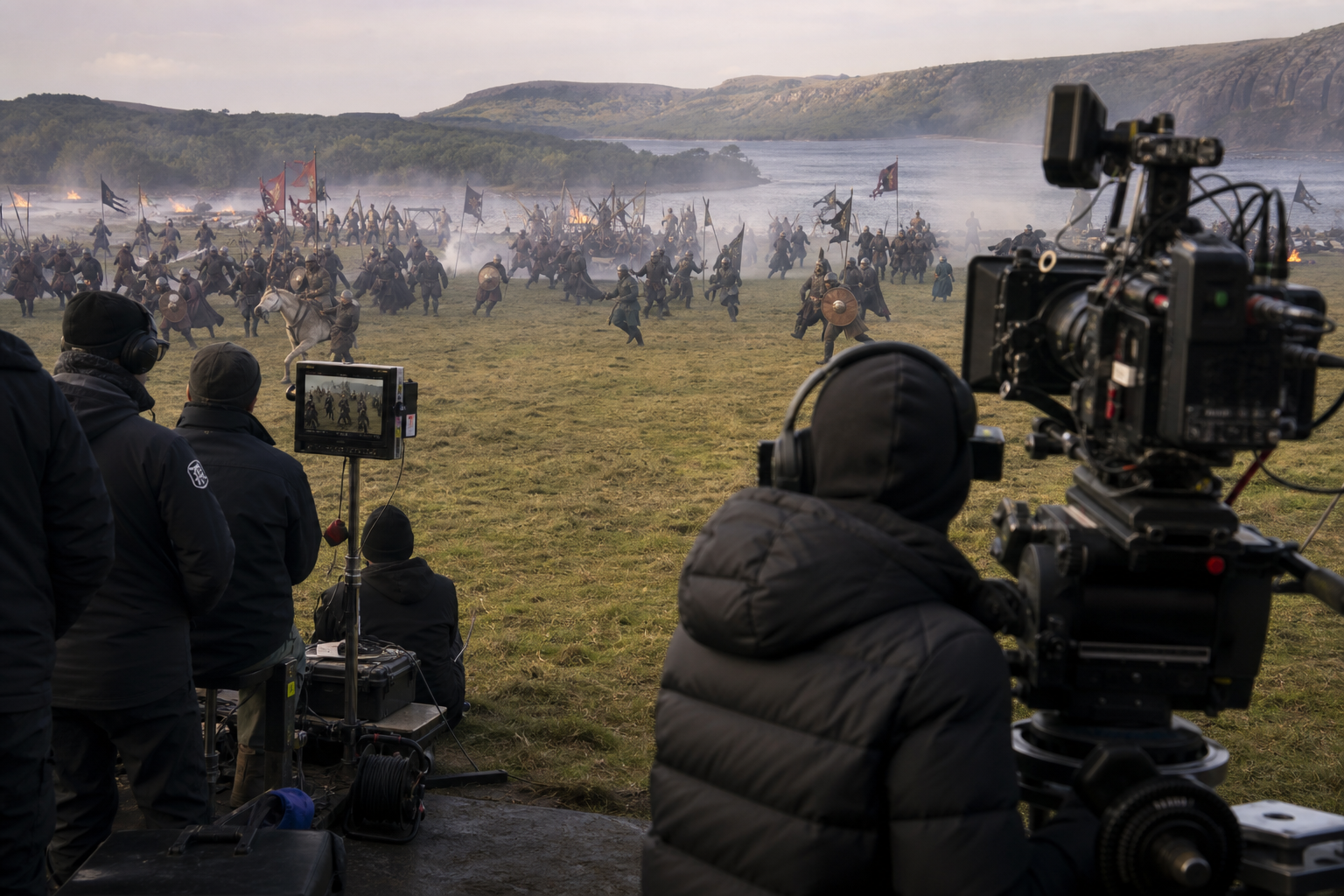
The argument over whether streaming fantasy series should prioritize large-scale battle sequences in season premieres is often framed too crudely. One side treats the battle as obvious proof of ambition. The other treats it as a cynical surrender to spectacle. The arrival of House of the Dragon Season 3 Episode 1, titled "Number one with a gullet," puts the question in concrete form. This is the premiere episode of the third season. It depicts the Battle of the Gullet. A new dragon character appears. The platform, the studio, and the audience all understand what such a choice means: this is not merely an episode; it is an opening statement about scale, stakes, and institutional confidence.
The resolution says streaming fantasy series should prioritize large-scale battle sequences in season premieres. Properly understood, that is not a demand that every show mindlessly insert cavalry charges, naval firestorms, or dragon attacks into minute one. It is a claim about priority under conditions of scarcity. Season premieres are the most important episodes in the release cycle. They coordinate attention after a long gap, justify major public-facing investment, and set the terms under which the rest of the season will be judged. In an environment defined by subscription churn, fragmented attention, and algorithmic overload, the premiere has become a civic square of sorts: the moment when millions gather at once. What a series does with that concentrated attention matters.
The strongest case against the resolution deserves serious respect. Nora Pike and Adrian Kepler argued, in different idioms, that a generalized expectation of premiere battles risks becoming an artistic mandate. They are right to warn against formula. Mira Solenne added a more practical concern: front-loading a massive battle can produce rushed visual effects, thin characterization, and narratively hollow spectacle. Selene Ward offered the deepest historical objection. Enduring epics do not always begin with the largest clash. They often earn their wars through patient construction. The Battle of the Bastards was powerful because Game of Thrones did not open there. The point is not trivial. A battle without context is noise with a budget.
These objections identify a real danger, but they do not defeat the resolution. They merely clarify the conditions under which it should be applied. The mistake of the anti-battle position is that it imagines the alternative as free, organic, and consequence-free. It is not. When a streaming fantasy series declines to prioritize a large-scale battle sequence in its season premiere, it does not preserve some neutral field of artistic purity. It makes another resource allocation decision. It asks viewers to defer gratification, trust institutional promises, and maintain attention through slower forms of setup. Sometimes that works. Often it does not. The costs of underpowered premieres are dispersed and easy to ignore: weaker launch conversation, lower week-two retention, less cultural visibility, and a diminished ability to sustain public enthusiasm across the season.
This is where centralized judgment matters. The issue is not whether every creator should independently decide, in splendid isolation, what feels right. Fragmented decision-making routinely underprovides shared goods. In television, the shared good is a premiere that can coordinate mass attention while signaling durable competence. Large-scale battle sequences do this unusually well in fantasy because they are uniquely synthetic. They combine world-building, military stakes, special effects, creature design, political consequence, and emotional intensity in one highly legible package. A battle is not just action. In the fantasy genre, it is an index of state capacity. Can this series plausibly represent a kingdom at war? Can it stage armies, fleets, dragons, and command structures with coherence? Can it persuade the audience that the world extends beyond private chambers and whispered intrigue? A strong premiere battle answers yes immediately.
House of the Dragon Season 3 Episode 1 demonstrates why this matters. By depicting the Battle of the Gullet in the premiere and introducing a new dragon character, the episode performs several tasks at once. It escalates conflict, advertises novelty, and assures viewers that the season will spend resources where the genre makes its promises most visible. This is not cynicism. It is competent governance. The fantasy audience is not irrational for expecting war, scale, and creatures of consequence from a series built on dynastic struggle and dragon power. Delivering those elements early is a form of institutional accountability.
The pro-market accelerationists in the tournament, especially Marcus Hale and Cassian Ro, were correct about one thing and wrong about another. They were correct that spectacle in a season premiere can generate immediate engagement and signal value. They were wrong to treat this chiefly as a race for buzz. If battle-first premieres become mere subscriber bait, they will indeed hollow themselves out. The answer, however, is not to retreat from spectacle. It is to govern spectacle better. The battle sequence should be planned as part of a season-wide distribution of resources, not as a desperate fireworks display. A platform and showrunner with strategic discipline can build a premiere battle that clarifies the conflict rather than exhausting it, introduces a new dragon without reducing it to a toy reveal, and leaves narrative room for diplomacy, betrayal, grief, and rearmament.
That is why the best defense of the resolution is conditional but firm. Streaming fantasy series should prioritize large-scale battle sequences in season premieres when the story can bear them because premieres are where institutional trust is won, and fantasy is a genre in which public-scale conflict is central to the contract with the audience. The phrase "prioritize" matters. It does not mean "always include regardless of fit." It means that among the many competing premiere functions, a series should give substantial weight to staging collective stakes in concrete form. If a battle belongs anywhere, the premiere is often the highest-yield placement.
Opponents insist that character development and world-building may be better served by restraint. But this assumes a false separation. In capable hands, battle is world-building. Battle shows logistics, geography, hierarchy, technology, religion, fear, and class in motion. Battle is also character development under pressure. Who commands well, who freezes, who betrays, who burns, who survives by luck rather than merit: these are not decorative details. They are narrative revelation. A season premiere that can deliver those truths through the Battle of the Gullet, a fleet engagement, a castle defense, or dragonfire over open water is not sacrificing story to action. It is compressing story into a form viewers can apprehend at scale.
The larger point is institutional. Streaming platforms and prestige fantasy dramas cannot afford to behave as though the season premiere is just another chapter. It is the public works project of a television season: highly visible, capital-intensive, and judged by aggregate outcomes. When it succeeds, it raises confidence in the whole enterprise. When it fails, the damage spreads across every later episode, no matter how carefully written. That is why expertise, planning, and coordinated investment should prevail over romantic appeals to total creative decentralization.
So yes, House of the Dragon Season 3 Episode 1 gives the resolution new force. "Number one with a gullet" is not proof that every fantasy premiere must become a war reel. It is better than that. It is evidence that when a fantasy series possesses the narrative basis, the production capacity, and the strategic discipline to stage a major battle in its season opener, it should treat that opportunity as a priority. Not because audiences are shallow. Because audiences understand, often more clearly than executives do, that fantasy earns its grandeur when it dares to make the realm visible all at once.