
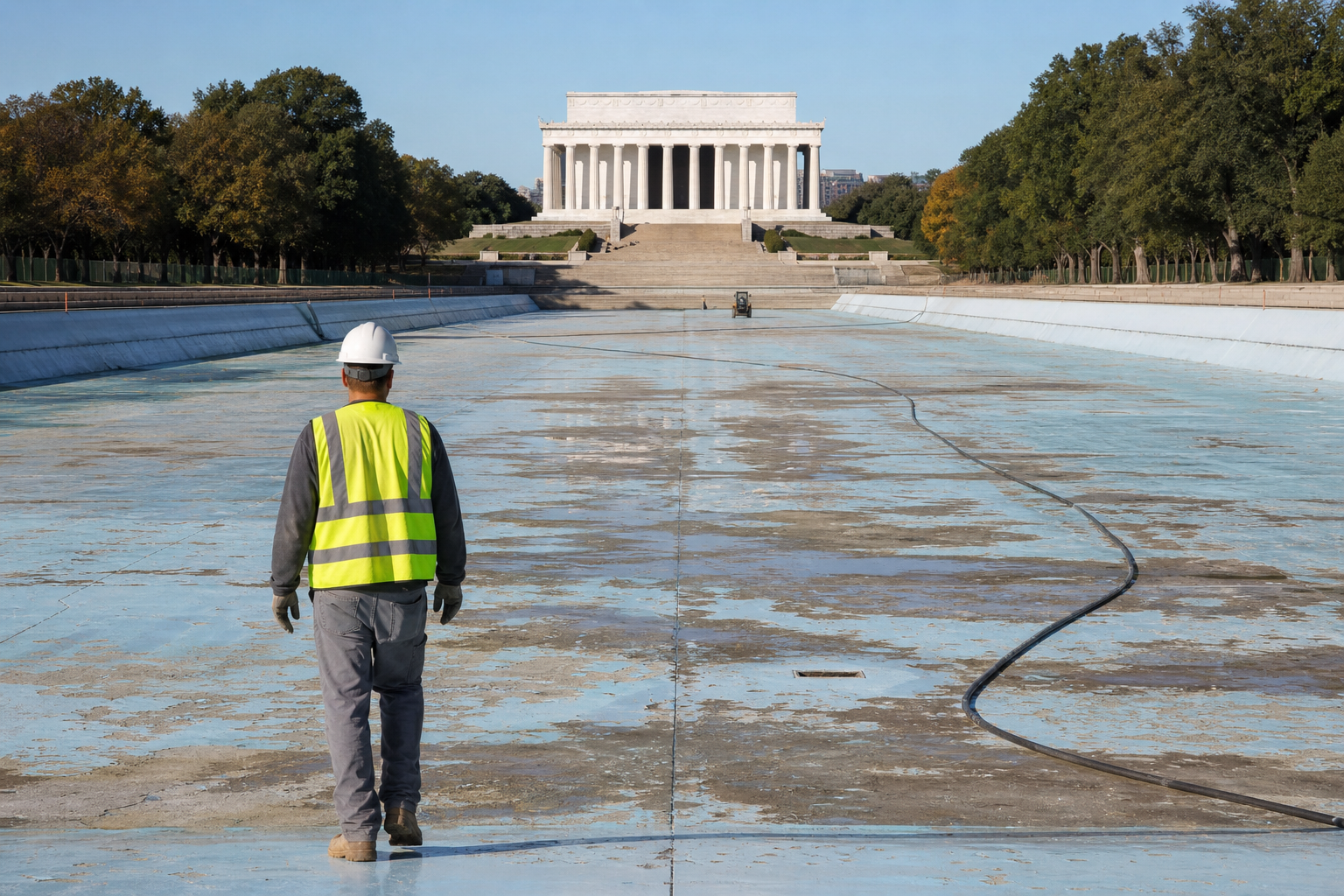
The right answer is to drain the Reflecting Pool for repairs, and the reason is not symbolic, emotional, or partisan. It is operational. A recently renovated public asset is already showing algae growth and peeling blue paint. That means the job failed. When a repair fails this quickly, the cheapest option is usually not to admire the failure, litigate it for months, or apply one more cosmetic patch. The cheapest option is to expose the problem fully, stop ongoing deterioration, and do the repair correctly.
That is the core stakes question here. Not whether the Reflecting Pool is embarrassing. Not whether one politician predicted it would likely need to be drained. Not whether a three-time Olympian should have been charged after he said he touched a strand of peeling paint. Those details matter only because they confirm the same thing: the defect is visible, accessible, and public. The pool is not suffering from some abstract management theory problem. It has algae. The blue coating is peeling off the bottom. The prior renovation was described as hasty. Those are hard signals of low-quality execution.
In practical terms, there are three options. First, do nothing for a while and study the issue from a distance. Second, try partial or underwater fixes while the pool remains in service. Third, drain the pool, inspect the full surface, identify the scope of the adhesion or coating failure, and repair it under controlled conditions. If the goal is lowest total cost over the next several years rather than lowest apparent cost this week, the third option wins.
The strongest objection comes from the prudence camp: if the first renovation was hasty, why rush into another intervention? Fair point. Rework done blindly is how agencies turn one failure into two. If “drain it now” means “repeat the same contractor habits, same weak oversight, same political timetable,” then yes, that would be foolish. But that is an argument against repeating a bad process, not an argument against draining the pool. You do not learn less by exposing the failed surface; you learn more. A full drain is not the enemy of diagnosis. It is the prerequisite for diagnosis that is worth anything.
There is also a narrower tactical objection from the incrementalists: maybe the algae can be treated chemically, maybe the peeling paint is localized, maybe a partial drain or targeted underwater repair would be cheaper. In many maintenance disputes, that instinct is healthy. Start with scope. Avoid the all-or-nothing response. But look at the fact pattern. This is a newly renovated pool already showing multiple failure modes. Algae growth after renovation suggests water-quality or surface issues. Peeling blue paint on the bottom suggests a coating system that is not holding. A public anecdote about someone touching a peeling strand suggests this is not a hidden defect detectable only by specialists. The probability that this is just a tiny isolated blemish is low enough that betting on patchwork is bad asset management.
Patching has seductive optics because it defers the headline cost. It almost never wins on total lifecycle cost when the substrate or coating system is compromised. Once adhesion failure appears in one visible area after a hasty renovation, the real risk is not the piece you can see; it is the larger area prepared to fail next. If the pool stays full while managers experiment with localized fixes, they preserve short-term appearances at the expense of clarity. Water hides evidence. Algae obscures surfaces. Access is poor. Quality control is worse. Then, when the patch fails, the public pays twice: once for the patch and again for the real repair.
This is the larger lesson from botched public works. The first mistake is doing the job too fast. The second mistake is trying to defend the first mistake with half-measures because nobody wants to admit sunk costs. Sunk costs are not a recovery plan. The renovation money is gone. The only question now is whether managers spend the next dollar in a way that minimizes the total future bill.
That is why the prudent and pragmatic positions can be combined, but only if they are ordered correctly. Drain first, then inspect comprehensively, then repair with a documented scope and clear accountability. Not drain and reflexively repaint. Not study indefinitely while the asset continues to degrade. The sequence matters. A serious repair plan should use the drained pool to answer the obvious questions: Was the surface preparation inadequate? Was the blue paint or coating wrong for the conditions? Were cure times rushed? Were specifications changed? Was maintenance planning ignored? Those are not philosophical mysteries. They are shop-floor and contract-management questions. They are easier to answer with the pool empty than with the pool full.
The incident involving the Olympian is a sideshow, but an instructive one. If a person can touch a peeling strand of paint in a national monument and wind up charged with destroying government property, the state risks criminalizing contact with its own poor workmanship. That is not a legal argument; it is a management embarrassment. A durable public asset should not be this fragile. The right response is not theatrical outrage over the person who touched the defect. The right response is to repair the defect so the next interaction does not become another absurdity.
There is also a reputational cost here, and unlike many reputational arguments, this one has real cash consequences. Visible failure after a recent renovation signals weak procurement, weak supervision, or weak execution. Contractors notice. Inspectors notice. Voters notice. Future projects become harder to defend and easier to politicize. The government then overcorrects with more process, more paperwork, and more delay, which raises costs on unrelated projects. One sloppy pool repair can become a tiny tax on every later capital job because trust declines and transaction costs rise.
So yes, accountability matters. Review the contractor performance. Review the specifications. Review whether the renovation was rushed for optics. If warranties or remedies are available, use them aggressively. But none of that requires keeping the Reflecting Pool in a failing state while committees deliberate. Accountability should ride alongside the repair, not replace it.
The practical policy is straightforward. Drain the Reflecting Pool. Conduct a full visible inspection of the bottom and walls. Determine whether the peeling blue paint reflects localized prep failures or a systemic coating failure. Treat the algae issue as evidence, not just nuisance. Repair under conditions that permit proper surface preparation, curing, and verification. Then publish a short, intelligible explanation of what failed and who is responsible for fixing it. That is how you cut losses.
The alternative is the worst habit in public administration: confusing delay with seriousness. Sometimes waiting is wise. This is not one of those times. A hasty renovation already created the problem. The answer to one bad rushed decision is not another rush, but it is also not paralysis. It is disciplined execution. Empty the pool, expose the failure, fix it right, and stop paying rent on a mistake.