
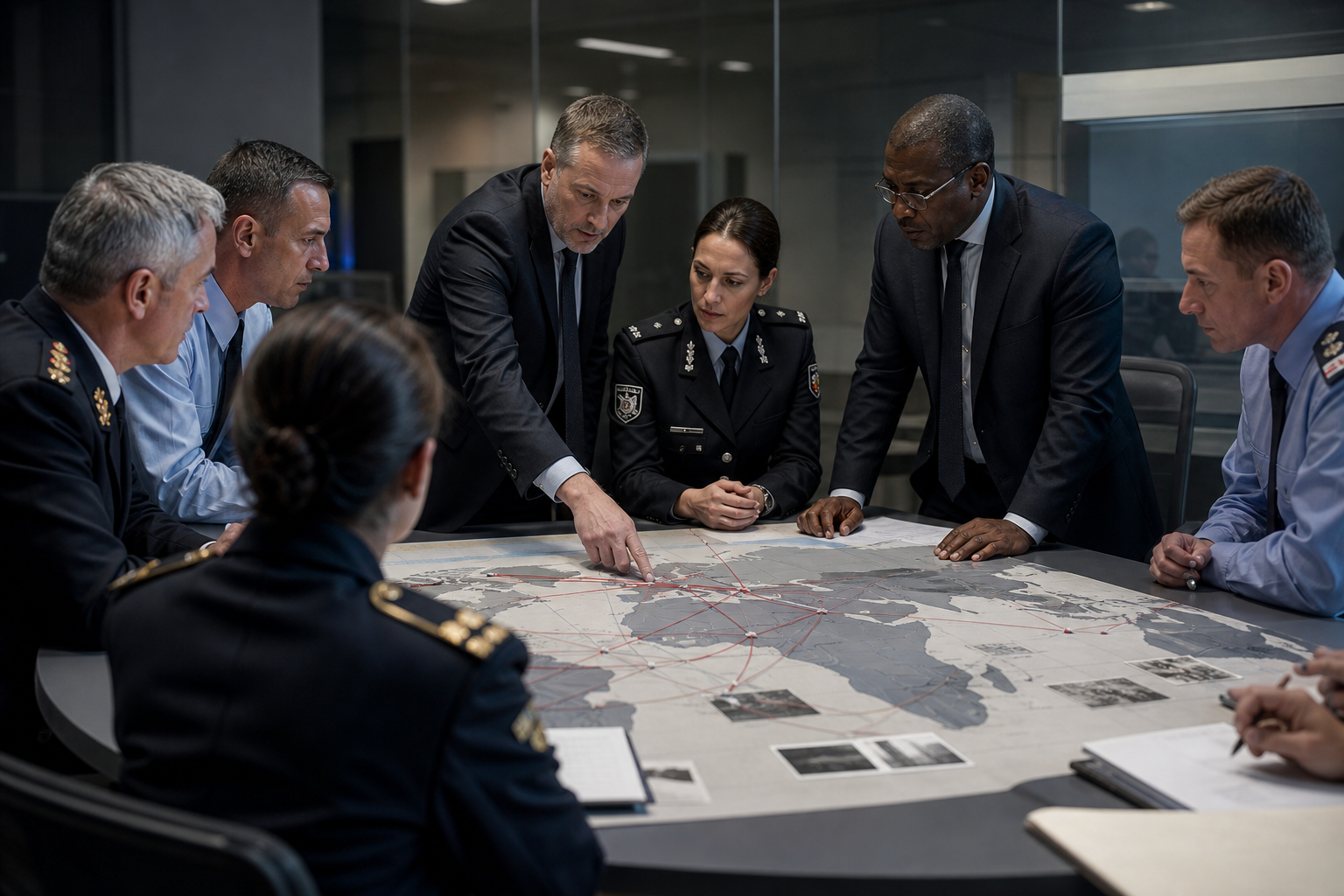
A bomb attack in Monaco has produced the kind of case that tests whether governments have actually adapted to modern terrorism or are still performing sovereignty by habit. Police are searching for a Ukrainian suspect, officials believe the suspect may have had accomplices, the suspect was reportedly disguised as a man, and investigators say surveillance of the attack location took place over multiple days. Every one of those facts points in the same direction. This was not a purely local act with a neatly local solution. It was a cross-border terrorism case, and law enforcement should prioritize international cooperation over domestic resources when investigating such cases.
That claim is often misunderstood. It does not mean abandoning the crime scene in Monaco. It does not mean pretending local police, forensic teams, witness interviews, and immediate perimeter control are optional. They are not. They are indispensable. But they are indispensable inputs, not the strategic center of gravity. In a case where the suspect is tied to another country, may have crossed jurisdictions, and may have operated with accomplices, the central investigative problem is not simply what happened at the blast site. The central problem is how to identify, locate, disrupt, and prosecute a network that may already be moving across borders faster than any one domestic agency can follow.
The strongest argument against prioritizing international cooperation is a practical one. Domestic responders are on the ground first. They secure the scene, preserve evidence, identify victims, review local camera footage, gather phone records available under domestic law, and interview witnesses while memories are fresh. International requests can be slow. Diplomatic channels can be cumbersome. Different countries have different evidentiary rules, privacy standards, and operational tempos. In the first hours after an attack, no serious official should wait for a multinational committee to decide what to do.
That objection is correct as far as it goes, and too narrow where it matters most. The resolution is about prioritization in cross-border terrorism investigations, not about who tapes off the street first. The choice is not between local evidence collection and international cooperation. Any competent state does both. The question is which one should organize the investigation as a whole, receive the higher strategic emphasis, and command the greater urgency in resource allocation once cross-border indicators are present. In this Monaco case, those indicators are not speculative. They are explicit.
A Ukrainian suspect is not merely a biographical detail. It immediately raises the probability of international travel records, foreign communications, overseas financial traces, identity fraud issues, and possible logistical support outside Monaco. A disguise suggests premeditation and counter-surveillance awareness, which in turn suggests training, facilitation, or at least planning that exceeds opportunistic violence. Belief in accomplices means the attack was likely not the work of a single isolated actor. Multi-day surveillance of the target location means there was enough time to coordinate movement, reconnaissance, procurement, and escape. A domestic investigation can uncover part of that picture, but if it remains the primary frame, it will systematically underperform against the actual topology of the threat.
This is the recurring failure of fragmented enforcement. Local agencies tend to optimize for what they can directly control: the scene, the nearby cameras, the local witness pool, the domestic legal file. Those are necessary tasks, but they create an illusion of completeness. Terror networks benefit from exactly that fragmentation. One jurisdiction sees the surveillance. Another sees the travel. Another sees the money trail. Another sees an associate. Another has intelligence on false documents or prior extremist contact. No single domestic agency, however capable, can lawfully or operationally assemble that entire mosaic alone. If international cooperation is treated as an auxiliary step, the investigation will lag at precisely the point where speed matters most.
This is why prioritization matters. Prioritizing international cooperation means immediate activation of cross-border intelligence channels, rapid requests through established police and judicial mechanisms, synchronized watchlists, coordinated border alerts, shared biometric and identity data where lawful, and parallel investigative tasking across relevant states. It means structuring the case from the outset as a transnational manhunt and network disruption effort, not as a local bombing inquiry that later expands if needed. That sequence is the difference between chasing a suspect and constraining a system.
Critics often describe this as ceding sovereignty. It is the opposite. In modern counterterrorism, sovereignty is not the theatrical insistence that every serious problem be handled in-house. Sovereignty is the capacity to mobilize the full machinery of lawful state power, including allied and treaty-based capacities, to protect the public. Monaco does not become weaker by compelling cooperation from foreign partners. It becomes more effective. The state that insists on acting alone when the facts are transnational is not defending sovereignty. It is narrowing its own reach.
There is also a fairness and public safety dimension that should not be ignored. Cross-border terrorism imposes costs that fragmented domestic systems predictably underprice. Delayed information sharing can leave other cities exposed. Failure to identify accomplices can permit secondary attacks. Weak coordination can allow suspects to exploit asylum, extradition, or data silos. The burden of these failures does not fall evenly. Smaller states, densely connected urban areas, migrants vulnerable to backlash, and ordinary civilians in tourist or commercial zones bear the greatest risk when governments treat international cooperation as a diplomatic add-on rather than an operational priority. Centralized coordination exists because the costs of under-cooperation are socialized across borders.
It is true that international investigations raise legitimate concerns about due process, evidentiary integrity, and accountability. Different legal systems do not fit together seamlessly. That is a reason to improve formal frameworks, not a reason to retreat into domestic primacy. Indeed, prioritization of international cooperation is the better way to preserve legal rigor, because early coordination reduces the chance of contaminated evidence, conflicting timelines, duplicated interviews, or ad hoc intelligence swaps that later collapse in court. Planned state-to-state cooperation is more accountable than improvised patchwork.
The opposing side in this debate usefully reminds us that there is no substitute for strong domestic capacity. That is right. No one should hollow out local forensics, intelligence analysis, or emergency response in the name of cosmopolitan abstraction. But robust domestic capacity is the platform, not the priority, in cross-border terrorism cases. Its role is to generate high-quality evidence quickly and feed it into a wider, centrally coordinated international apparatus that can pursue suspects, identify accomplices, and prevent follow-on harm across jurisdictions.
The Monaco bombing illustrates the point with unusual clarity. A suspect linked to another country, allegedly disguised, possibly aided by accomplices, and involved in days of prior surveillance cannot be investigated as if the meaningful perimeter ends at Monaco's border. The attack site is local. The threat environment is not. Law enforcement should say so plainly and build accordingly.
When terrorism crosses borders, the investigation must do the same, immediately, systematically, and as a matter of priority. Domestic resources remain essential, but they should serve a larger architecture of international cooperation. That is not symbolism. It is the only serious way to match state power to the scale of the problem.