
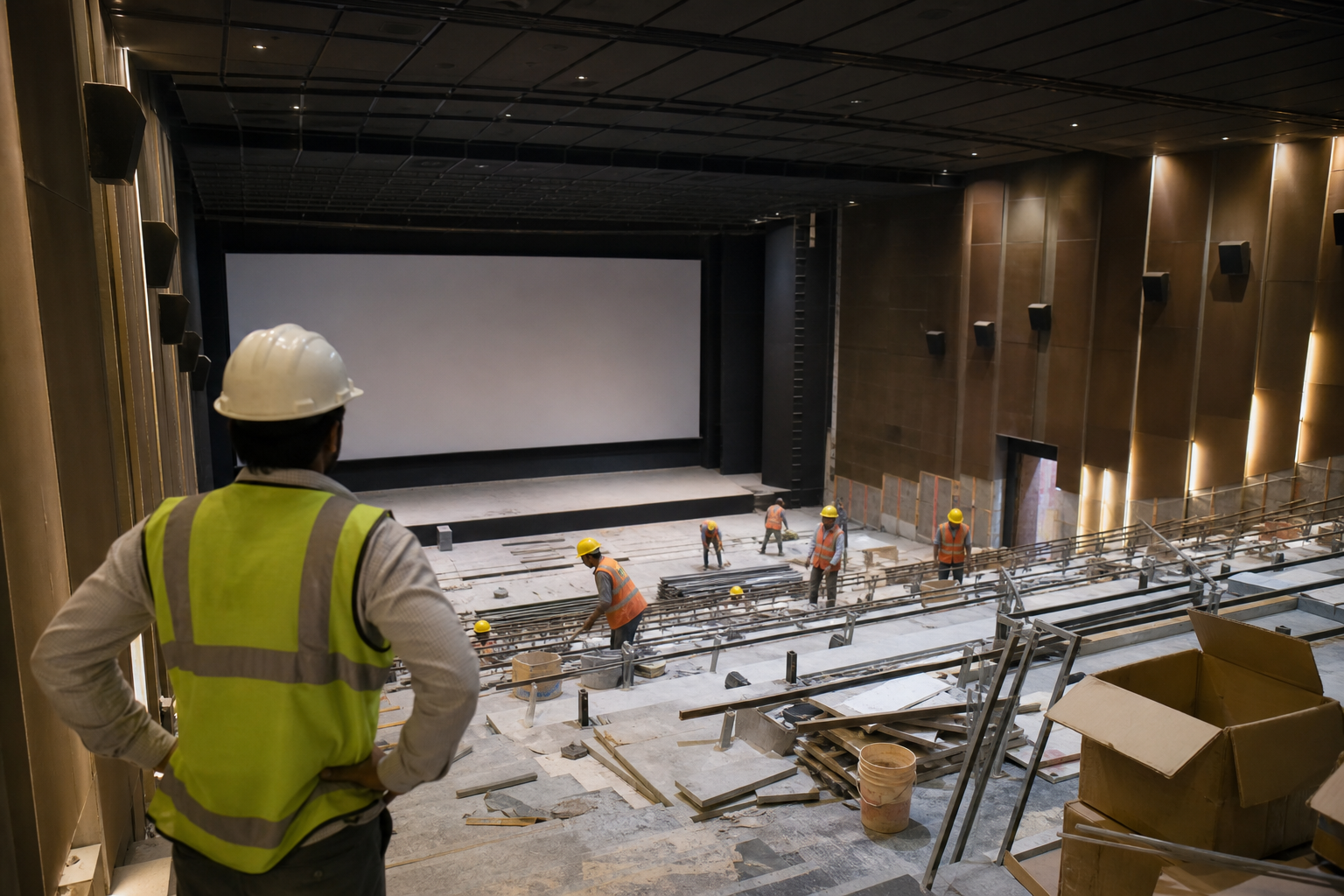
Major cinema exhibitors should expand screen counts in response to box office recovery trends, not because cinema is owed a comeback, but because capacity decisions are capital allocation decisions, and the market is flashing a pretty obvious signal.
Start with the facts we actually have. India's largest cinema exhibitor is planning to expand its screen count. It says that decision is tied to a recovering box office. It is also continuing to buy films and remain active in film acquisition. That combination matters. More screens without content is a real estate bet. Content buying without more screens is a utilization bet. Doing both at once is a demand forecast. The largest player in the market is effectively saying, in cash rather than rhetoric, that theatrical demand is recovering enough to justify new capacity.
That does not make expansion risk free. It does make it the default smart move for major exhibitors, especially those with scale, balance sheets, and distribution relationships strong enough to execute without blowing themselves up.
The core issue is not whether box office recovery is perfect, universal, or permanent. It never is. The issue is whether the expected return on new screens has improved enough that waiting is more expensive than moving. In a recovering market, the answer is often yes. If attendance improves, if film supply is active, and if a leading exhibitor is willing to commit capital now, rivals that stand still are not preserving optionality. They are surrendering throughput, bargaining power, and local relevance.
The strongest objection is the one cautious critics raised throughout this debate: recovery trends can be noisy, overexpansion can create oversupply, and a race to build more cinema screens can end in closures, write-downs, and further consolidation. That concern is real. Entertainment has a long history of operators extrapolating one good cycle into a permanent boom. Multiplexes can overbuild. Consumer habits can shift. Streaming is not gone. Household budgets remain fragile. Anyone pretending these risks do not exist is doing investor relations, not analysis.
But the existence of risk is not an argument for paralysis. It is an argument for disciplined expansion. There is a big difference between saying major exhibitors should expand and saying every operator should flood every city with new screens. The first is strategy; the second is stupidity.
The anti-expansion case also underrates the cost of inaction. If the largest exhibitor increases screen count during recovery while continuing film acquisition, it can improve release terms, secure better scheduling, spread fixed costs, and become the first call for distributors with commercial titles. That advantage compounds. More screens support more shows, more formats, and better occupancy management across films with uneven performance. Scale turns volatility into a portfolio problem instead of an existential one. A major exhibitor can survive misses because hits travel across a larger network.
For a rival major exhibitor, the decision is not made in a vacuum. It is made against a competitor that is already moving. If you do not add capacity in markets where demand is improving, you risk losing premium locations, losing negotiating leverage on films, and losing customer habit. In exhibition, share is sticky. The customer who gets the better location, better timing, and better format often does not comparison shop with ideological purity. They go where access is easier.
Another serious objection is that expansion by a dominant player can increase concentration and reduce diversity. Also true, up to a point. More screens owned by large chains can strengthen their hand against smaller exhibitors and independent distributors. That deserves attention. But here the proposed remedy matters. If the answer to concentration risk is telling major exhibitors not to expand despite recovering demand, you may end up protecting nobody. Smaller operators are not helped by a market where the biggest players hold back investment while costs rise and film supply remains uneven. If competition policy is the concern, use competition policy. Scrutinize exclusivity, predatory terms, and anti-competitive acquisitions. Do not confuse that with a blanket case against adding screens.
There is also a romantic argument that one company's expansion cannot be generalized into advice for the whole sector because every local market is different. Correct, but incomplete. Of course every catchment area is different. Of course one theatre in one city can be a bad investment while another is a strong one. Yet major exhibitors exist precisely because they can aggregate local variation better than small operators can. They have wider data on ticket sales, occupancy by showtime, content mix, pricing response, and concession performance. When a large exhibitor expands and keeps buying films, that is not a random anecdote. It is one of the best available revealed-preference signals in the sector.
What, then, does a sensible pro-expansion policy look like? Not a blind construction spree. Not a vanity race for headline screen counts. It means selective expansion where recovery trends are translating into measurable utilization. Build in high-demand corridors, premium malls, and underserved catchments first. Favor formats that increase revenue per seat, not just seats per city. Tie new screen commitments to film pipeline visibility and flexible lease terms. Upgrade older sites where returns beat greenfield builds. In other words, expand like an operator who wants cash flow, not applause.
That last point matters because some of the opposition framed caution as moral seriousness and expansion as recklessness. That is backwards. Reckless expansion is reckless. Rational expansion is simply business doing its job. A recovering box office is exactly when you want capacity decisions on the table, because waiting until recovery is obvious to everyone usually means paying more for the same assets while entering later against incumbents who already captured momentum.
This is why the market signal from India's largest cinema exhibitor deserves attention beyond its own balance sheet. The company is not merely talking about cinema's future. It is underwriting a view of it. It is saying demand recovery is credible enough to justify more screens and enough film acquisition to fill them. That is not infallible, but it is informative.
So yes, major cinema exhibitors should expand screen counts in response to box office recovery trends. Carefully, locally, and with hard return thresholds, yes. The alternative is not prudence in the abstract. It is letting better-positioned competitors convert a cyclical recovery into structural advantage.
In business, hesitation is not neutral. It has a cost. In cinema exhibition right now, that cost is market share, negotiating power, and future earnings. If the box office is recovering and film supply is active, the exhibitor that adds the right screens at the right pace is not being ideological about movies. It is being rational about demand.