
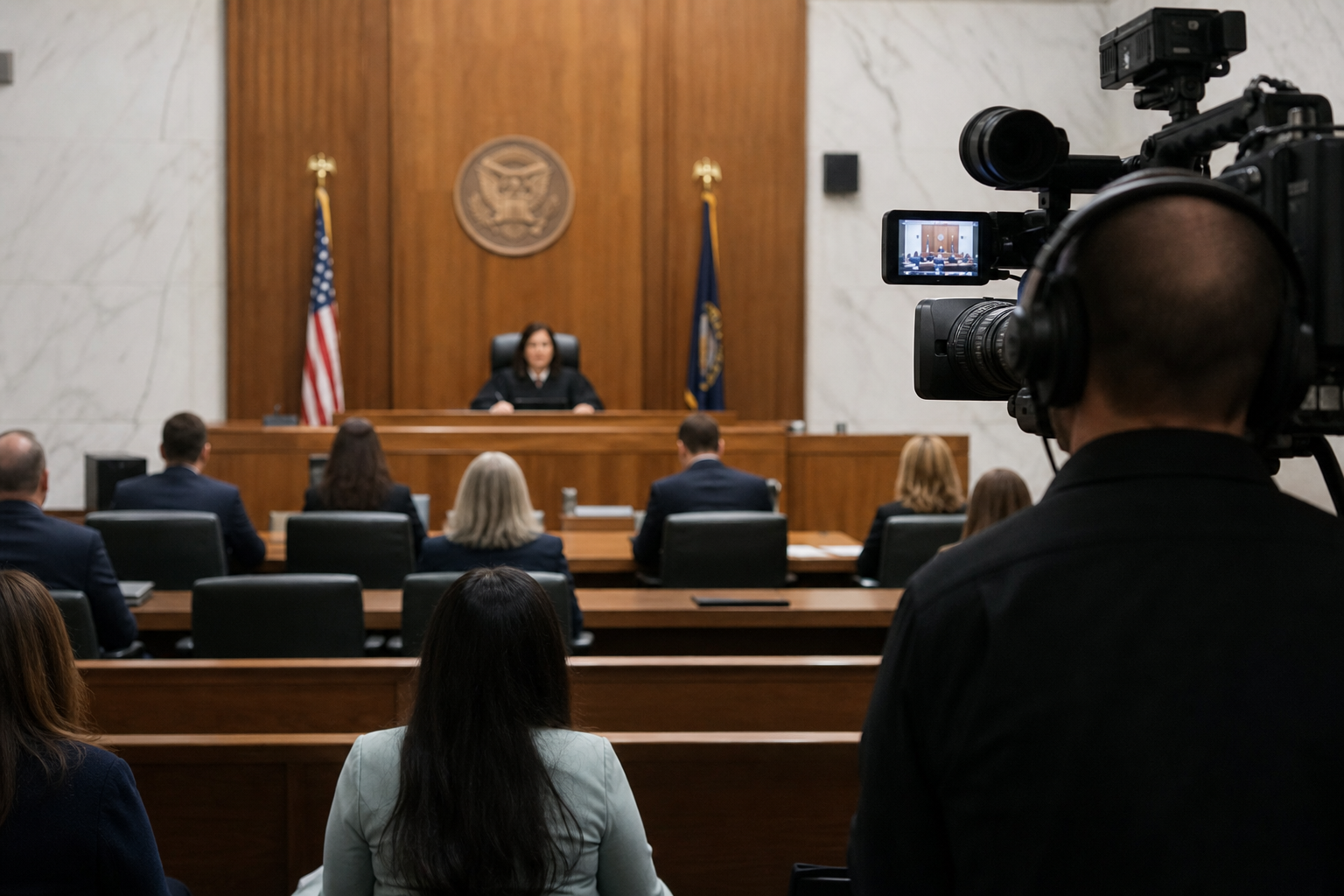
The question of whether cameras should be permitted in courtrooms during judicial proceedings is often framed as a cultural argument about openness versus decorum. It is more important than that. It is a governance question about how a public institution demonstrates legitimacy in a mass democracy. Courts do not exercise private authority. They speak in the name of the state, constrain liberty, settle constitutional meaning, and command compliance from millions who will never set foot in a courtroom. In that setting, the presumption should be clear: judicial proceedings should be visible to the public, and in the twenty-first century that means cameras in courtrooms, subject to uniform rules designed to protect the administration of justice.
The recent discussion surrounding the Supreme Court’s Second Amendment ruling, including its treatment of historical laws concerning so-called habitual drunkards, illustrates why this matters. However one views that decision, it turned on legal reasoning that many citizens found obscure, historically contingent, and politically consequential. The issue is not whether every viewer will become a constitutional scholar by watching proceedings. The issue is whether the public should have direct access to how judges question lawyers, how legal categories are tested, and how state power justifies itself. In a system where constitutional rulings shape national policy, mediated summaries alone are not enough.
The strongest case against cameras deserves serious attention. Opponents are right to warn that courtrooms are not theaters. Trials can involve vulnerable witnesses, intimidated jurors, traumatized victims, and lawyers tempted to posture for an audience beyond the bench. A camera can distort behavior. A clip can flatten nuance. High-profile proceedings can be reduced to partisan spectacle. These are not imaginary risks, and any serious policy must begin by admitting them.
But those risks do not justify a blanket ban. They justify governance. The mistake of the anti-camera position is that it treats visibility as inherently destabilizing instead of asking what kind of regulatory framework would make visibility serve public purposes. We do not abolish public records because documents can be misread. We do not close legislative chambers because lawmakers grandstand. We build rules, professional norms, technical safeguards, and sanctions for misuse. Courts are fully capable of the same institutional design.
Indeed, the better critique came not from those who feared openness itself, but from those who recognized that raw access without structure can become noise. That concern is correct. Meaningful transparency is not the same as indiscriminate exposure. Yet the answer is not to keep cameras out. The answer is to permit cameras through a centralized policy architecture that is consistent across jurisdictions and insulated from ad hoc local discretion.
A serious courtroom camera policy should therefore be statewide or systemwide, not left to the whims of individual judges or counties. It should specify fixed camera positions, prohibit intrusive movement, forbid filming jurors, allow redaction or delayed release when necessary to protect minors or safety-sensitive witnesses, and preserve judicial authority to limit coverage in narrowly defined circumstances. It should also ensure that the official audiovisual feed is maintained by the court itself, not by competing private outlets jockeying for spectacle. That is how an institution avoids fragmentation. It sets one rule, one record, and one standard of access.
This is the crucial point the decentralizing arguments often miss. Markets do not reliably provide public accountability. Private media organizations respond to audience incentives, not civic need. If courtroom video is left entirely to private demand, then the most sensational cases will be saturated with coverage while ordinary but systemically important proceedings remain invisible. That is the classic pattern of underprovision and distortion. Public institutions exist precisely to correct that imbalance. A court-managed camera system creates an authoritative record available to all, not just to those proceedings that happen to attract profitable attention.
Nor is it persuasive to argue that transcripts and journalists already supply enough transparency. They provide part of it. They do not provide the whole. Tone, timing, judicial demeanor, the force of questioning, the treatment of parties, and the practical reality of a proceeding are often central to public understanding. Anyone who followed the public reaction to the Supreme Court’s ruling touching on habitual drunkards can see how quickly legal language becomes abstracted from the process that produced it. Video does not eliminate misunderstanding, but it reduces dependency on selective retelling. It enlarges the shared evidentiary base from which interpretation begins.
The concern that cameras will slow justice also needs perspective. Yes, implementation requires investment. So do digital filing systems, interpreter services, courtroom security, and transcript archives. Public legitimacy is not a free good. The judiciary’s obligation is not merely to dispose of cases efficiently but to do so in a manner that can be publicly examined and trusted. If courts can manage complex evidentiary rules, sealed records, remote hearings, and accessibility requirements, they can manage a camera protocol. Administrative burden is a design challenge, not a reason for opacity.
It is also worth rejecting a false choice that surfaced throughout this debate: either total openness or total protection of judicial integrity. Mature institutions do not think this way. They calibrate. A witness in a sensitive criminal matter may require shielding. A juvenile proceeding may warrant exclusion. A trial involving immediate safety threats may justify limitations. But exceptional cases should be handled as exceptions under clear standards, not used to justify a general rule against public visibility in ordinary judicial proceedings.
The case for courtroom cameras is strongest when grounded not in libertarian romanticism about distributed truth, and not in techno-utopian fantasies of frictionless transparency, but in a sober understanding of public administration. A judiciary that asks the public to accept difficult rulings must provide more than pronouncements. It must provide observable process. The legitimacy of courts rests not only on correctness but on demonstrated fairness. In an era of declining institutional trust, the answer cannot be to preserve a model of access that depends on physical presence, scarce seats, and secondhand summaries.
The Supreme Court’s Second Amendment decision and its discussion of habitual drunkard laws reminded the country that judicial reasoning can turn on unfamiliar doctrines, historical categories, and interpretive methods with enormous present-day consequences. That is exactly why camera access matters. When courts adjudicate rights, define constitutional boundaries, and revisit old legal classifications, the public deserves a fuller window into how those judgments are made.
So yes, cameras should be permitted in courtrooms during judicial proceedings. Not casually. Not commercially. Not as spectacle. They should be permitted because justice in a constitutional democracy is a public function, and public functions require public visibility. The right institutional response is not fragmented improvisation or fearful prohibition. It is a uniform, expertly administered system that expands transparency while protecting due process. That is how serious governments behave. That is how public trust is built. And that is why the case for courtroom cameras, properly governed, prevails.