
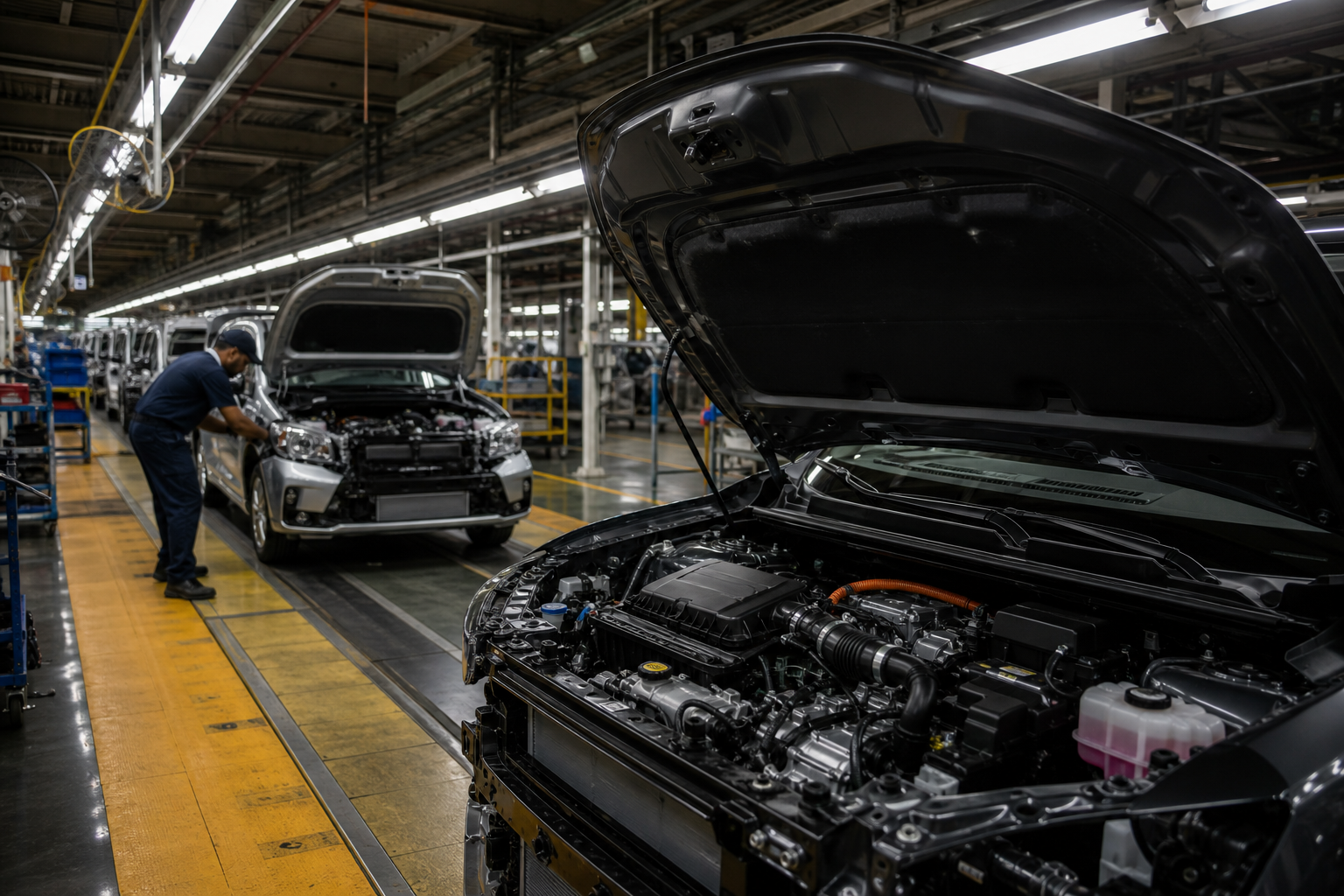
The policy question is simple: when automakers decide where to allocate factories, engineers, batteries, dealer attention, and marketing dollars, should they prioritize hybrid vehicles or fully electric vehicles? Right now, the answer is hybrids. Not forever, not as theology, and not because battery electric cars have no future. The answer is hybrids because capital is finite, demand is real, and the auto business punishes companies that confuse aspiration with throughput.
The fact pattern matters. Hybrid vehicle sales are increasing in the U.S. car market. Electric vehicle demand is declining. Hybrids offer functional advantages compared to EVs, especially for buyers who want fuel savings without dependence on charging access, long charging times, or range planning. Hybrids are priced competitively relative to EVs. Most importantly, market trends show hybrids are no longer viewed as transitional technology. They are not just a stepping stone people tolerate on the way to something else. For a large and durable slice of the market, they are the product.
That should change how automakers think. Prioritizing production is not the same as making a philosophical statement about the distant future of transportation. It is a decision about what to build more of, now, with scarce capacity. In that setting, the first obligation is not to flatter elite narratives about inevitability. It is to match output to demand, preserve margins, avoid stranded inventory, and move the largest number of lower fuel use vehicles into driveways at a price people will pay.
The strongest case for fully electric vehicles is not hard to state. EV advocates argue that a hybrid-first strategy risks delaying the full transition, prolonging investment in internal combustion systems, and reducing pressure to build charging infrastructure. They argue that markets are myopic, that consumers optimize for short-term convenience, and that automakers should lead rather than follow. There is force in that argument. If you think battery electric vehicles are the endpoint, then every dollar placed into hybrids can look like a dollar not placed into the endpoint.
But that critique fails a basic execution test. Transitions do not happen because executives announce them. They happen when products clear the market at scale. If EV demand is weakening while hybrid demand is strengthening, then insisting on an EV-heavy production mix does not accelerate the future. It creates discounting, inventory buildup, weaker cash flow, and investor pressure. In other words, it burns the very financial capacity needed to fund future EV development.
This is the central mistake in the anti-hybrid case. It treats production as a moral signal. It is not. It is a capital allocation problem. Automakers cannot spend the same dollar twice. A vehicle that sells profitably today does more for long-run innovation than a vehicle that sits on a lot because planners assumed the customer would catch up. Hybrids generate volume. Volume supports supplier investment, factory utilization, dealer confidence, and retained earnings. Those are not side issues. They are the mechanism by which companies stay solvent enough to keep investing.
There is also a practical consumer point that opponents underweight. Hybrids solve a real set of use cases better than EVs do today. They work for apartment dwellers without home charging. They work for households with one car that must handle commuting, road trips, school pickup, and bad weather without planning around chargers. They work for price-sensitive buyers who want lower fuel consumption but cannot justify a higher monthly payment. They work in regions where public charging remains inconsistent. When a product fits more lives, it earns more demand. That is not market irrationality. That is product-market fit.
Some critics respond that consumer preference is only a snapshot, and snapshots should not drive industrial strategy. Fair point, up to a point. Markets can be shortsighted. But automakers are not national planning agencies; they are operating businesses in a cyclical, brutally competitive industry with high fixed costs. If management treats current demand as irrelevant, someone else will not. The competitor that offers the right mix of hybrids and sells into visible demand will take share, earn profit, and gain the strategic freedom the idealists claim to want.
Another argument says that prioritizing hybrids perpetuates fossil fuel dependence. Also true, narrowly. A hybrid still has an engine. But this objection confuses absolute purity with comparative improvement. The real comparison in the current market is not between a hybrid sold and a perfect EV world magically realized. It is often between a hybrid sold and an older, less efficient gasoline vehicle kept longer, or a would-be EV buyer walking away because the proposition does not work for them. If the goal is to reduce fuel use across the fleet in the world as it exists, then a high-volume hybrid strategy can beat a lower-volume EV strategy.
This is where second-order effects matter. Suppose automakers over-prioritize EVs in a cooling demand environment. They tie up battery supply in vehicles that move slowly, raise incentives to clear inventory, compress margins, and teach consumers to wait for discounts. They also raise political backlash by making electrification look like a top-down imposition divorced from cost and convenience. That backlash is not abstract. Once consumers feel pushed into products that do not suit them, they stop trusting the transition itself. Hybrids reduce that friction. They widen participation instead of narrowing it to high-income homeowners with easy charging.
The debate also turned on whether hybrids are merely transitional technology. The facts suggest that framing is outdated. Transitional products are tolerated temporarily despite weak intrinsic appeal. Hybrids now have their own durable value proposition: better fuel economy than conventional gas cars, easier daily use than many EVs, and competitive pricing. That is enough to sustain a category. Automakers should stop talking about hybrids as a consolation prize and start treating them as a core line of business.
None of this requires abandoning EVs. That is the false binary that distorts the conversation. Prioritize does not mean exclusively produce. It means put more incremental capacity behind the product with stronger demand, broader usability, and better near-term economics. Keep investing in electric vehicles, battery improvements, software, and charging partnerships. But do not starve the business in the name of symbolic commitment. Let EVs win on performance and economics when they are ready to clear the market more consistently. Until then, build the thing customers are asking for.
The smart automaker strategy is straightforward. Expand hybrid production where waiting lists and sales momentum justify it. Protect EV programs that have real demand and strong unit economics. Cut vanity bets, not future options. Use profits from hybrids to fund disciplined EV development rather than forcing EV volume at any cost. That approach is less glamorous than all-in rhetoric, but it is much more likely to survive contact with reality.
The broader lesson is uncomfortable for every camp that prefers narratives to numbers. Technology transitions are not won by choosing the purest endpoint and demanding that consumers cooperate. They are won by reducing friction, earning trust, and compounding adoption. In today’s U.S. auto market, hybrids do that better than fully electric vehicles. Automakers should prioritize them, because the fastest route to the future is the one people are willing to drive home now.