
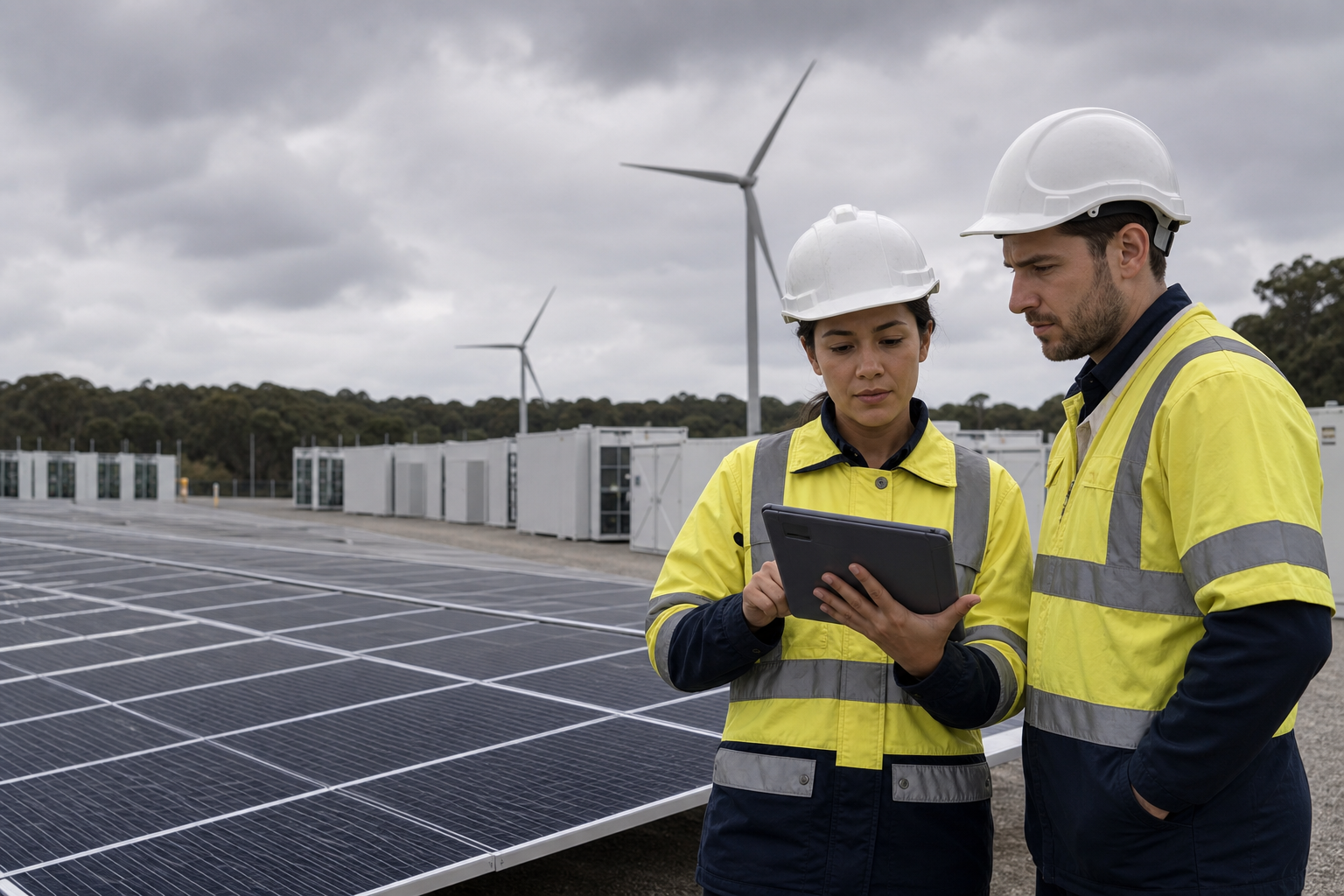
When Australian Prime Minister Anthony Albanese compares artificial intelligence policy to the renewable energy transition, critics hear a slogan. They should hear a warning, and an opportunity. The warning is that AI is no longer a laboratory curiosity or a niche software market. It is becoming general infrastructure for decisions, labor, education, health care, finance, media, and public administration. The opportunity is that governments do not have to improvise from scratch. They already know what a pivotal technological transition looks like, and they know that leaving it entirely to private speed produces concentrated power, social dislocation, and expensive cleanup after preventable damage.
That is why governments should regulate AI development using frameworks similar to renewable energy transition policies. Similar does not mean identical. AI is not electricity, and machine learning models are not solar farms. But the governing logic travels well. In both cases, the state is dealing with a transformative technology that promises broad gains, generates serious externalities, depends on upstream infrastructure, and evolves quickly enough to outpace ordinary case by case law. In both cases, the public interest requires a policy mix, not a single ban or subsidy. That mix includes standards, disclosure rules, procurement choices, investment in shared infrastructure, transition support, and oversight calibrated to risk.
The strongest argument against this analogy deserves respect. AI is moving faster than the energy sector did. The technology is less settled, the use cases are more diverse, and overbroad rules could lock in today’s incumbents while freezing tomorrow’s entrants. This is not a trivial concern. We have seen in other sectors how compliance costs can become a moat for large firms, and how vague safety rhetoric can be captured by those already closest to government. Anyone serious about AI policy should concede that a bad regulatory framework could entrench the biggest model developers, burden startups, and hand strategic advantage to jurisdictions with weaker safeguards.
But that is an argument for better design, not for deregulation. Renewable energy transition policy at its best was never just prohibition. It combined emissions standards with public investment, research support, grid planning, market rules, consumer protections, and long time horizons. Applied to AI, the lesson is not to smother development, but to direct it toward public value and away from foreseeable harm. A government can set baseline safety testing for high impact models, require documentation and audit trails for consequential uses, fund public compute or data access for research, support workforce transition, and use procurement to reward systems that are transparent, secure, and fit for purpose. That is not central planning. It is governance.
The accelerationist objection is more seductive and more dangerous. It says the cost of delay is so large, in medicine, discovery, productivity, and scientific progress, that any friction is reckless. On this view, the renewable analogy fails because energy transitions are managed and gradual, while AI must be allowed to compound at maximum speed. This argument has one virtue, it takes the upside seriously. Governments should take the upside seriously too. AI can improve drug discovery, optimize transport, expand accessibility tools, and increase administrative capacity. It would be foolish to write policy as though the only thing at stake were risk containment.
But speed is not a defense against duty of care. The fact that a technology has enormous upside is precisely why its failures can scale so widely. A flawed search engine can mislead millions. A flawed foundation model embedded into hiring, lending, welfare administration, policing tools, and clinical triage can alter life chances at population scale. A privacy breach in one app is a scandal. A privacy breach in an AI ecosystem trained on vast data troves is a structural problem. A biased human manager can be sued or removed. A biased automated system can reproduce that bias across thousands of decisions before the first appeal is even processed.
This is where the renewable energy comparison becomes especially useful. Clean energy policy was built around a simple recognition, market enthusiasm alone does not internalize systemic risk or distribute benefits fairly. The same is true for AI development. Firms racing to release models have incentives to externalize testing gaps onto users, workers, schools, and public institutions. They may underinvest in red teaming, security, explainability, and misuse prevention because those costs are borne immediately while harms are dispersed later. That is the classic setting for public intervention.
And unlike some abstract future danger, several AI harms are already visible. Algorithmic bias is not speculative. Privacy erosion is not speculative. Fraud, impersonation, synthetic media abuse, and opaque automated decisions are not speculative. Nor is labor disruption. None of this means every model is catastrophic. It means the burden of proof should rest more heavily on those deploying systems into high stakes environments than on the people subjected to them. Consumers should not have to become their own auditors. Workers should not have to discover hidden scoring systems only after they are denied a job. Patients should not learn by experience that an untested model was stitched into a clinical workflow.
Opponents often reply that renewable transition policy had a clear target, decarbonization, while AI lacks a single agreed end state. Fair point, but it cuts less deeply than advertised. Governments regulate many general purpose technologies without needing one grand destination. They set conditions for safe use. They impose reporting and liability rules. They separate low risk from high risk functions. They require impact assessments where harms are concentrated. For AI, the absence of a single end state is a reason to build flexible, risk based frameworks, not to leave the field ungoverned.
So what would a renewable style AI framework actually look like in Australia or elsewhere? First, tiered obligations. General experimentation should face light touch rules, while systems used in employment, credit, education, health, policing, border control, and core government services should meet higher standards for testing, documentation, human review, and appeal. Second, infrastructure policy. Governments should invest in public interest compute, standards bodies, and secure research environments so safety and competition are not monopolized by a few firms. Third, procurement and labeling. Public agencies should buy AI systems only when vendors can demonstrate performance, security, and accountability, and citizens should know when AI is making or shaping important decisions. Fourth, transition support. If AI changes labor markets the way energy transition changed industrial regions, then retraining, bargaining power, and social adjustment are not side issues. They are part of the policy.
This is the deeper mistake in the anti regulation case. It treats regulation as drag and innovation as motion. In reality, the absence of trusted rules often slows adoption, because institutions, workers, and consumers reasonably fear systems they cannot evaluate or contest. Good governance can accelerate beneficial AI precisely by making it more reliable, more legible, and more socially legitimate. Renewable energy expanded not only because technology improved, but because policy reduced uncertainty, built infrastructure, and aligned private incentives with public goals. AI needs the same kind of settlement.
Albanese is right about one thing above all, this is a pivotal moment. Pivotal moments are when societies decide whether to govern powerful systems before those systems govern them. The renewable energy transition offers a useful model not because AI is the same, but because both demand public direction under conditions of urgency, uncertainty, and high stakes. The burden of proof should not fall on the public to absorb foreseeable harm in exchange for promised future gains. Governments should regulate artificial intelligence development using frameworks similar to renewable energy transition policies, because responsible progress is not the enemy of innovation. It is the condition that makes innovation worthy of public trust.